
Alone Together: The Quiet Collapse of Human Connection
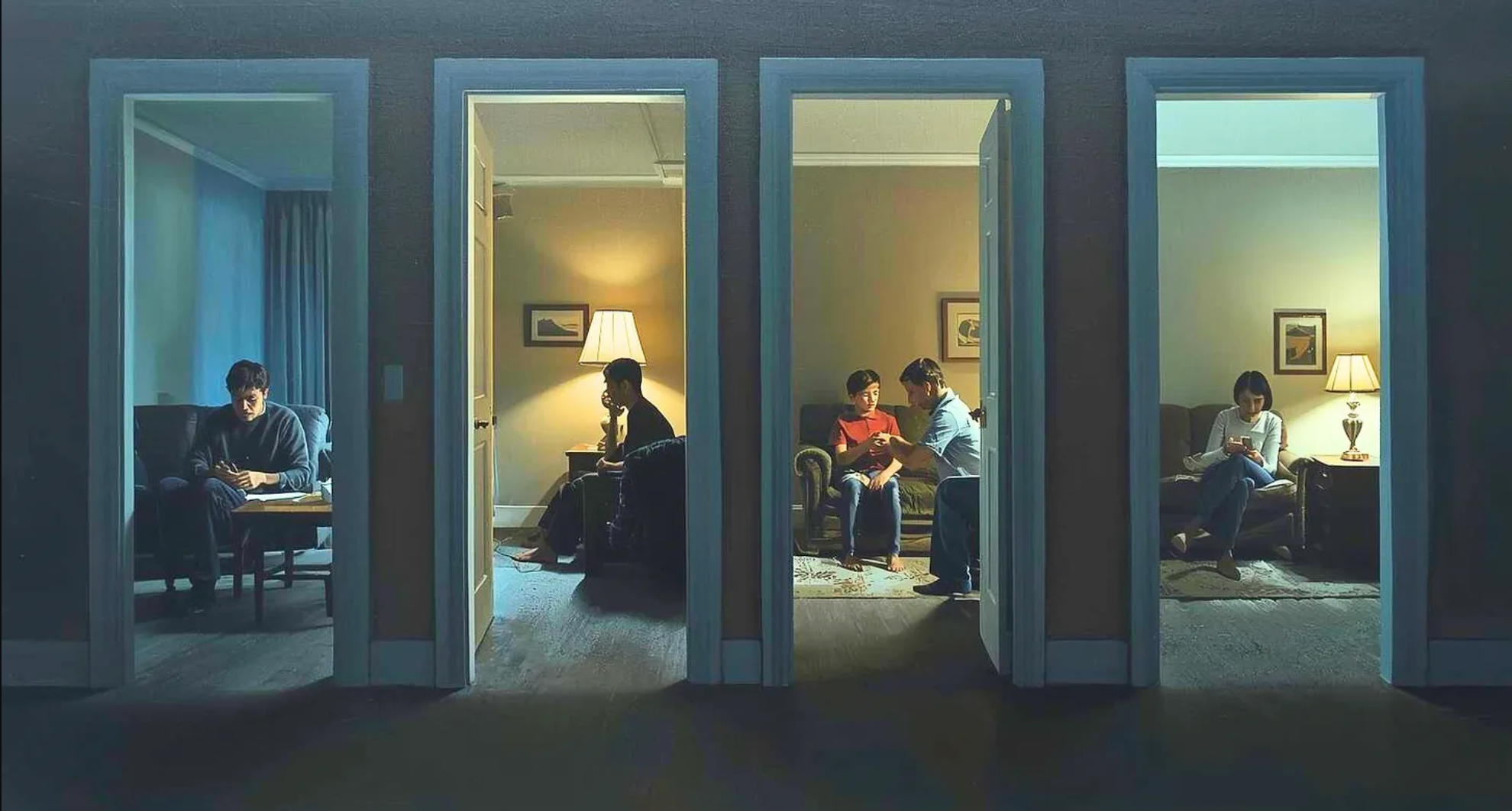
Alone Together: The Quiet Collapse of Human Connection
Why modern life is making us lonelier, sicker, and more divided—and what remembering how to belong might change
We talk endlessly about polarization, loneliness, anxiety, addiction.
We diagnose symptoms with precision and debate solutions with intensity.
And yet, something essential is still being missed.
The real crisis beneath all of this is disconnection—not just from one another, but from ourselves, from meaning, and from any shared sense of belonging.
What we are living through is not merely a social or political fracture.
It is a relational collapse.
And lately, it’s accelerating.
Disconnection Is Not an Accident
Human beings evolved in tribes. Not metaphorical ones—real ones.
Small groups where you were seen daily, known across time, corrected and protected in equal measure. Where children were raised by many eyes, where elders carried memory, where suffering was witnessed instead of hidden.
Connection wasn’t a lifestyle choice. It was the fabric of survival.
Today, we live surrounded by people and starving for contact.
We interact constantly, yet relate rarely.
We communicate endlessly, yet feel unseen.
We are “connected” digitally while being profoundly alone emotionally.
This didn’t happen because humans suddenly became weak.
It happened because the structures that once held us together quietly dissolved—and nothing meaningful replaced them.
Social Media and the Illusion of Belonging
Social media did not create loneliness.
It scaled it.
At first, it promised connection. What it delivered was performance, comparison, and fragmentation.
Online, we curate identities instead of living them.
We broadcast opinions instead of engaging in dialogue.
We measure worth in likes rather than relationships.
Our nervous systems—designed for face-to-face attunement—are now flooded with constant stimulation and micro-rejections. Every scroll subtly asks: Am I enough? Do I belong? Am I winning or losing?
The answer is almost always: You are behind.
This doesn’t just isolate individuals.
It fractures communities.
When people stop gathering physically, they stop practicing the skills required for real connection: patience, empathy, repair, accountability. Outrage replaces conversation. Labels replace curiosity. The “other” becomes abstract—easy to judge, easy to hate, impossible to know.
Disconnection grows louder. Faster. More contagious.
The Disappearance of Community—and the Cost to Children
At the same time, community itself has thinned.
Neighborhoods no longer function as villages.
Extended families are scattered.
Shared rituals—religious, civic, cultural—have weakened or disappeared.
Into this vacuum, we placed enormous pressure on the nuclear family—often one already stretched beyond capacity.
In many households, both parents must work outside the home simply to survive. This is not a moral failure; it is an economic reality. But it comes with consequences we rarely name honestly.
Parents are exhausted.
Children are overstimulated and under-attuned.
Time together is fragmented, rushed, and mediated by screens.
Kids are not just missing supervision.
They are missing presence.
They grow up without enough adults who know them deeply, without enough unstructured time to belong, without enough mirrors to help them make sense of who they are.
So they turn—understandably—to substitutes.
Screens.
Substances.
Approval.
Numbing.
Mental Illness and Addiction Are Not Random
The rising rates of anxiety, depression, self-harm, and addiction are not mysterious.
When people lack secure attachment, meaning, and belonging, the nervous system remains in a chronic state of threat. Over time, the body looks for relief.
Drugs numb pain.
Scrolling distracts from emptiness.
Anger provides a fleeting sense of power.
Identity offers belonging when community fails.
These are not signs of weakness.
They are adaptations to a disconnected world.
But adaptations become prisons when they replace real relationship.
We keep trying to fix individuals without examining the culture that is breaking them. We prescribe pills and coping strategies without asking the deeper question:
What kind of world are we asking humans to survive in?
The Truth We Avoid
Here is the uncomfortable truth:We have built a society that prioritizes productivity over presence, efficiency over relationship, and individual success over collective well-being.
And humans are paying the price with their mental health.
Disconnection doesn’t just hurt—it destabilizes.
It erodes empathy.
It fuels extremism.
It makes people easier to manipulate, angrier, more hopeless, more desperate for meaning.
A disconnected person is easier to control.
A connected one is harder to divide.
That is not accidental.
And Still—This Is Not the End of the Story
Despite everything, something quiet but powerful is happening.People feel it in their bones: This isn’t working.
Endless scrolling, numbing, performing, consuming—it’s not a life. There is a growing hunger for depth, truth, and real belonging.
And here is the hopeful part:
Connection can be rebuilt.
Not through apps or slogans.
Not through nostalgia or denial.
But through intentional, often uncomfortable, profoundly human choices.
It begins when we slow down enough to be present.
When we choose face-to-face over filtered.
When we rebuild small circles of trust.
When children are once again held by community.
When we stop outsourcing meaning to algorithms and start cultivating it together.
Real connection requires effort.
It requires courage.
It requires learning how to stay when it would be easier to scroll away.
But it is still possible.
And it is still powerful.
The Way Back Is Relational
We do not heal disconnection by winning arguments or perfecting ourselves.
We heal it by remembering how to belong.
By listening instead of labeling.
By choosing community over convenience.
By tolerating difference without demonizing it.
By offering presence in a world addicted to distraction.
This is not sentimental work.
It is revolutionary.
Because a society rooted in connection is harder to fracture, harder to numb, and harder to turn against itself.
If we want a different future, it will not be engineered.
It will be relationally rebuilt—one human connection at a time.
And it starts closer than we think.
The real crisis beneath all of this is disconnection—not just from one another, but from ourselves, from meaning, and from any shared sense of belonging.